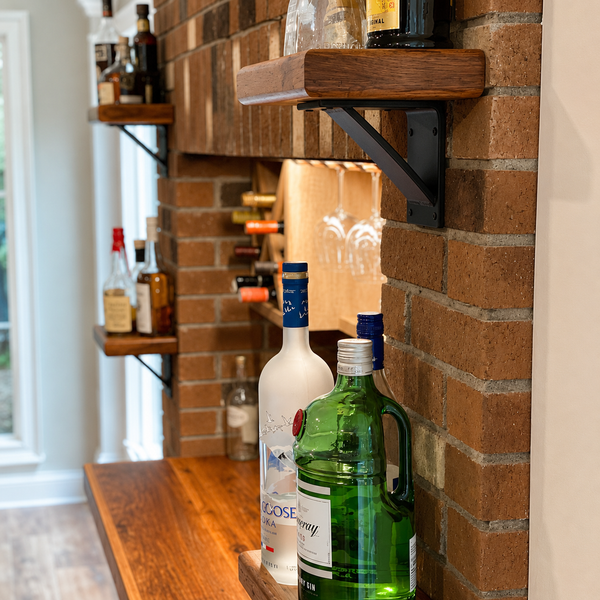
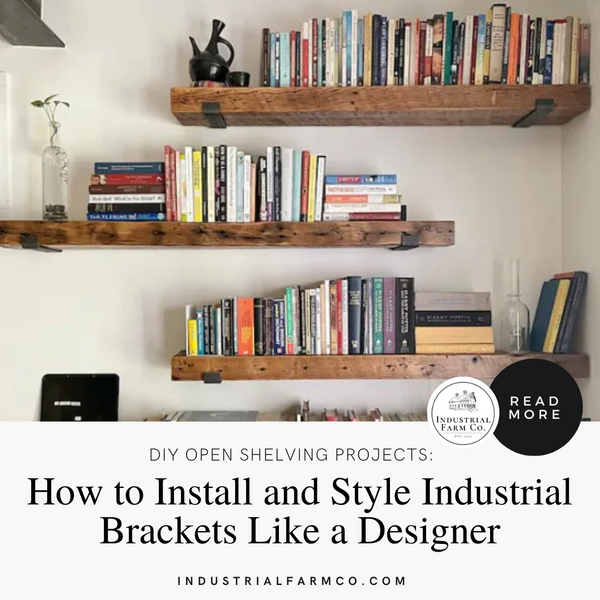
Open shelving is more than just a storage solution—it's an opportunity to express your style while creating a functional kitchen space. By carefully considering your needs, choosing quality materials, and maintaining a balance between practical and decorative elements, you can create open shelving that enhances the function and beauty of your industrial farmhouse kitchen.
Kitchen open shelving on steel brackets is one of the highest-impact changes you can make to a kitchen without touching the cabinetry, countertops, or appliances. One wall of upper cabinets replaced with open wood shelving on iron brackets immediately changes the feel of the room: more light, more visual depth, and everything you need visible and accessible without opening a door.
Industrial Farm Co. makes steel shelf brackets for kitchen use in Camillus, New York. Our farmhouse bracket collection handles heavy kitchen loads; our minimalist bracket line gives a cleaner look for contemporary kitchens. All are made to order in matte black, raw steel, or custom finishes and ship within 7 business days.
Understanding the Industrial Farmhouse Kitchen Style
Industrial farmhouse kitchen design combines clean lines, metal accents, and natural materials. Open shelving is its defining storage element: the wood board on a steel bracket pairs the warm farmhouse material with the hard industrial hardware. The combination reads as considered and handmade in a way that closed upper cabinets rarely do.
Planning Your Open Shelving
Wall structure: Locate wall studs before deciding where brackets go. Shelves should mount into studs whenever possible. Stud location determines bracket placement, which determines how you handle gaps between studs. For walls where studs don’t align with your preferred bracket positions, use toggle bolts rated for at least twice your expected load.
Weight: Calculate what the shelf will actually carry. A shelf holding stacked plates, bowls, and cast iron is far heavier than it looks empty. Size your brackets and fasteners for the loaded weight, not the board weight alone.
Depth and spacing: Standard kitchen shelf depth is 10-12 inches for plates and bowls. Deeper shelves (14-16 inches) accommodate larger items and small appliances. Allow 12-18 inches between shelves for comfortable reach and clearance when pulling items out. Position the first shelf 18-24 inches above the countertop.
Selecting Your Hardware
The bracket is the load-carrying element. Choose by these criteria:
Depth: Bracket should reach at least 75% of the shelf depth. A 12-inch shelf needs a bracket reaching at least 9 inches.
Load rating: For a fully loaded kitchen shelf, plan for 50-100+ pounds per shelf depending on contents. Size your bracket and fastener accordingly.
Finish: Matte black is the most consistent with a full industrial farmhouse kitchen. Raw steel is the most authentically industrial. Both read correctly against natural wood shelf boards.
Our industrial bracket collection handles heavier loads with more visual presence. Our minimalist bracket line gives a clean profile for kitchens where you want the shelf board and the objects on it to be the visual focus. Both are available in matte black and custom finishes.
Installation Tips
Mark and level: Draw a level line across the wall at your desired shelf height. Mark bracket positions along the line. Use a template if you’re installing multiple identical shelves at the same heights.
Secure mounting: Into studs with 3-inch lag screws wherever possible. Pre-drill pilot holes. Check level on each bracket individually before tightening fully. Once all brackets are at the same height and level, tighten completely.
Attach the shelf: Pre-drill the shelf board through the bracket mounting holes to prevent splitting. Secure from underneath. Check level one final time before loading the shelf.
Styling Your Shelves
Everyday items: Group frequently used items at easy reach. Create zones for specific activities: a coffee station on one section, baking essentials on another. Everything on open shelving should be something you use regularly or something worth displaying.
Visual balance: Mix heights and textures — a row of books, a stack of bowls, a glass jar, a trailing plant. Include both vertical elements (vases, bottles) and horizontal (stacked dishes, folded linens). Leave 30-40% of the shelf surface empty. The empty space makes the objects on it readable.
Color: The industrial farmhouse kitchen uses a neutral palette. Stick to natural wood, white dishes, clear glass, and one accent color from plants or a small textile. Avoid filling the shelf with too many colors or competing patterns.
Maintenance and Care
Open kitchen shelves collect grease and dust faster than closed cabinets. Weekly dusting and a monthly wipe-down with a damp cloth keeps the shelf surfaces and bracket finishes in good condition. Periodically check bracket tightness, especially after heavy loading or if the shelf carries a lot of cast iron. Tighten any loose screws before the looseness compounds.
Making It Work Long-Term
Keep frequently used items on open shelves; store rarely-used items in closed cabinets if you have them
Rotate what’s on the shelves seasonally to prevent dust accumulation on items that sit too long in one position
Add wall hooks below or beside the shelves for frequently grabbed items like dish towels, oven mitts, and measuring cups
Distribute heavy items evenly across the shelf rather than concentrating weight at one end
Locate wall studs with a stud finder and mark a level line at the desired shelf height. Position brackets along the line at stud locations, no more than 24 inches apart. Mount with 3-inch lag screws into studs, pre-drilling pilot holes. Check level on each bracket before tightening fully. Attach the shelf board from underneath, pre-drilling through the bracket holes to prevent wood splitting. Check level one final time before loading.
How deep should kitchen open shelves be?
10-12 inches for plates, bowls, and everyday dishes. 14-16 inches for larger items and small appliances. The bracket should extend at least 75% of the shelf depth for proper support. A 12-inch deep shelf needs a bracket reaching at least 9 inches from the wall.
What bracket finish works best in a kitchen?
Matte black is the most consistent with a full industrial farmhouse kitchen and complements both light and dark wood shelf boards. Raw steel is the most authentically industrial option and develops a natural patina over time. Both read correctly against natural wood. Avoid chrome or brushed nickel in an industrial farmhouse kitchen — those finishes conflict with the material sensibility of the style.
How do you style open kitchen shelves?
Group frequently used items within easy reach and create zones for different activities. Mix heights and textures: a row of books, stacked bowls, a glass jar, a trailing plant. Leave 30-40% of the shelf surface empty — the empty space is what makes objects on the shelf readable rather than accumulated. Stick to a neutral palette with one accent color from plants or a small textile.
Do open kitchen shelves collect more dust than cabinets?
Yes, open shelves collect grease and dust faster than closed cabinets in a kitchen environment. Weekly dusting and a monthly wipe-down with a damp cloth keeps the surfaces in good condition. Rotate items that sit in one place too long to prevent dust accumulation. The trade-off is visibility and accessibility; many people find open shelves easier to maintain when they actually use everything on them regularly.